
study in New Zealand

New Zealand

8

Universities

1200 +

Courses
(UG :400 +
PG :800)
NZD
Currency

About New Zealand

Kia Ora!

Aspiring to study in New Zealand?

Explore the land where dreams meet adventure! New Zealand is the ultimate fusion of world-class education and breathtaking landscapes!

Whether it be curious study abroad aspirants or ambitious adults, New Zealand has gradually emerged as a prime destination for students of all ages in the past few decades. Actually, more than 50,000 international students opt for New Zealand annually for its quality education, peaceful atmosphere, and friendly people. With eight universities ranked among the best globally and an emphasis on innovation and practical learning, it is no wonder that students from all over the world are looking towards this island nation to restart their lives and have a promising future.

Studying in New Zealand is surprisingly affordable and exceptionally safe for international students. According to the official New Zealand government’s portal, typical living costs range from NZD 140 to NZD 484 per week for accommodation, and NZD 80–120 per week for groceries. The approximate cost of additional essentials is: utilities (NZD 200–300/month), transport (NZD 37/week), phone (NZD 19/month) and internet (NZD 90/month).

On the safety front, New Zealand consistently ranks among the world’s most peaceful countries: the 2025 Global Peace Index placed it 3rd globally, reflecting its low crime rates, stable governance, and strong public trust in law enforcement.

In a 2025 resident survey in Wellington, 97% said they felt safe at home at night, and 83% believed police acted professionally. For international students, this means a stable, welcoming environment backed by reliable emergency services like transit police, ambulance, and fire services, which are reachable via a toll‑free number (111).

Overall, New Zealand offers a great mix of affordable living and a very safe environment. With strong government support and trusted public services, it’s a smart and secure place for international students to live and study.

In addition, New Zealand universities and their qualifications are highly recognized and regarded by employers across the globe.

New Zealand is also known for its beautiful scenic beauty and adventure sports. The country majorly includes two main islands – the North and South Islands, and a number of tiny islands, some of which are hundreds of miles away from the main group. The capital of New Zealand is Wellington, and the largest urban area is Auckland; both are located on the North Island. Moreover, According to the EIU Global Liveability Index 2025, Auckland ranks 8th globally—placing it firmly among the world’s top cities for quality of life.

English, Māori, and New Zealand Sign Language are the official languages, with English being predominant and thus majorly spoken throughout the country.

It is recommended that students aspiring to study abroad take a deep dive into the entire journey, from the preparation, the courses and the admission process, to the paperwork and the visas.

Here you’ll find out more about top universities, top courses and reasons to study in New Zealand.

Why study in New Zealand?

  • Globally Recognized Universities
  • Te Pūkenga - New Zealand Institute of Skills and Technology, and hundreds of private training establishments.
  • Excellent Quality of Education
  • Top-Notch Campuses
  • Globally Recognized Courses
  • Post-Study Work Opportunities
  • Safe and Friendly Country
  • Politically Stable
  • Student-Friendly Campuses
Check out also reasons to study abroad, not only in New Zealand. Key 2025 Updates for International Students Announced by New Zealand Government
  • More Work Hours on New Visas: From 3 November 2025, eligible tertiary and senior secondary students with new student visas can work up to 25 hours a week during the semester (up from 20 hours). This applies to all new visas granted on or after this date, even if the application was submitted earlier.
  • Current Visa Holders: If your visa says 20 hours/week, you’ll need to apply for a change (variation of conditions or a new visa) to work 25 hours. Extra fees apply.
  • Exchange/Study Abroad Students: All tertiary students on approved exchange or Study Abroad programs (even for 1 semester) can now work while studying.
  • Changing Course or College: If you switch your university or move to a lower level of study, you’ll need to apply for a new student visa, not just change your current one.
  • School Students (Years 12–13): Still need permission from parents and school to work up to 25 hours per week.
  • No Pressure to Change: If your course is ending soon or you prefer to wait, you don’t have to apply for the extra work hours now. You can do it when you apply for your next visa.

Want to meet University Delegates from New Zealand?

Register on our Student Portal and we'll arrange for one-on-one meetings as the delegates are in India next!

Top Courses in New Zealand

    Top Courses Price Range (NZD)
    Hospitality and Tourism 18,000 - 35,500
    Business studies 22,500 - 45,000
    IT and Computer Science 24,000 - 51,000
    Cyber Security 17,852 -50,000
    Health Sciences 22,600 - 45,000
    Animation 19,800 - 39,000
    Arts and Humanities 23,000 - 45,000

New Zealand: Industry and Economic Outlook

Established

Established sectors: New Zealand has the world's 50th-largest national economy by nominal GDP and is experiencing promising economic growth across several industries.

In Demand Job Sectors

The emerging sectors in New Zealand are as follows
  • Healthcare
  • Engineering
  • Information and Communication Technology (ICT)
  • Biotechnology
  • Food and Beverage
  • Hospitality and Tourism
  • Education

Skill Shortages

The Long-Term Skill Shortage List
  • Construction Project Manager, Project Builder, Quantity Surveyor, Surveyor
  • Chemical Engineer
  • Civil Engineer, Civil Engineering Technician
  • Geotechnical Engineer, Structural Engineer
  • Electrical Engineer, Electronics Engineer, Industrial Engineer, Mechanical Engineer
  • Production or Plant Engineer
  • Environmental Engineer
  • Engineering Professionals
  • Telecommunications Engineer, Telecommunications Network Engineer
  • Procurement Manager
  • Clinical Psychologist, Diagnostic and Interventional Radiologist, General Practitioner
  • Medical Radiation Therapist, Medical Laboratory Scientist – including Cytotechnologist
  • Obstetrician and Gynaecologist
  • Physicist (Medical), Physiotherapist, Registered Nurse, Sonographer, Specialist Physician in Palliative Medicine, General Surgeon, Veterinarian
  • ICT, Electronics and Telecommunications
  • Recreation, Hospitality and Tourism
  • Environmental Research Scientist, Food Technologist
  • Automotive Electrician, Diesel Motor Mechanic, Electric Line Mechanic, Electrician (General)
The Regional Skill Shortage List
  • Apiarist, Arborist
  • Farm Manager, Crop Production/ Agronomist Manager
  • Pre-primary, Primary, and Secondary School Teachers, University Lecturer
  • Mechanical Engineering Draughtsperson
  • Accountant
  • Midwife, Healthcare Technicians, Resident Medical Officer, Specialist Physician (General Medicine), Cardiologist, Paediatrician, Specialist, Emergency Medicine Specialist, Ophthalmologist
  • Jockey, Outdoor Adventure Guide, Snowsport Instructor
  • Baker
  • Composite Technician, Electronic Equipment Trades Worker, Metal Casting Trades Worker, Metal Fabricator, Metal Machinist,
  • Motor Mechanic, Panelbeater
  • Plastics Technician, Sheetmetal Trades Worker, Vehicle Painter

Quick facts

life

Avg Living costs / per year

16,000 - 20,000

life

Avg Tuition Fee/Year

Undergraduate programs-22,000 - 32,000
Postgraduate programs:26,000-40,000
MBA:31,000-60,000

life

Indian students

20,000+

life

International students

100,000+

life

Avg graduate
incomes / Year

45,000 - 60,000

life

Migration possibility

YES

life

Intakes

Feb, July (with few universities offering multiple intakes in September and November)

life

Scholarships Available

YES

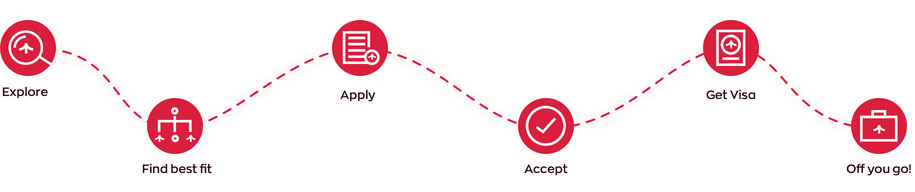
Global Ed Process

New Zealand FAQ

Students aspiring to study abroad often find it hard to select the country and the university that matches their interests and budget. However, if a student is willing to experience quality education with affordable tuition fees, then New Zealand is a fast-emerging and ideal study destination for them. Also, New Zealand is growing enormously in terms of research and development. Moreover, the universities of New Zealand are globally recognized and they cater to the personal needs of the students in the class. Overall, the benefits of studying in New Zealand are as follows:
  • Educational degrees and courses in New Zealand have global recognition.
  • Globally recognized universities with state-of-the-art facilities.
  • Quality higher education system: New Zealand’s higher education programs are well known for their quality of teaching and advanced facilities
  • Safe and friendly environment
  • Lower tuition fees and living expenses compared to other Western countries.
  • Part-time employment opportunities: Students can work part-time up to 20 hours per week while studying.
  • Post-study work permit: International students can apply for the post-study work visa for up to 3 years depending upon the level of qualifications as per NZQF.
The Visa management process starts as soon as the student receives the unconditional offer letter from the university along with a valid English Language Proficiency Test score (IELTS, PTE, TOEFL). The Chopras - TC Global follows a well-documented method for Visa Applications. You can start the Visa process for New Zealand a maximum of 120 days before the course/program start date. The student needs to undergo Medical and Police Clearance Certificate (PCC) before applying for a New Zealand visa. Moreover, preparing for a New Zealand visa application varies in complexity. For the visas, you'll need to get all the evidence together before you submit your application. Mainly, visas can be applied online. Others can be sent through us with the application forms, passport, and other supporting documents. We will then assess the documents, prepare the visa file, put a covering letter/summary, and forward it to the New Zealand High Commission through TT Services New Delhi along with the DD of visa fees. The visa interview is the final stage of the application process, where one of the Consular Officers will be responsible for asking questions to assess the applications. The New Zealand High Commissionwill then evaluate your application and the enclosed documents and make decisions like AIP (Approval In Principle) in approximately 2 to 4 weeks. Our visa team is fully equipped and experienced to guide you through the process. Please connect with our Relationships team and our Visa team, should you need any assistance with your student visa.
The student needs to transfer the living expense of one year to a bank account (ANZ Bank) in New Zealand, and pay the tuition fee. A student needs $18,000 to pay the living costs for each year of study in New Zealand. This is the minimum amount the student needs to transfer to the FTS(Fund Transfer Scheme) account. The tuition fee should be deposited to the university after receipt of AIP, from the funds shown in the Visa file. The amount deposited as FTS will be locked for twelve months and drip-fed to the student on a pre-arranged basis.
A student can apply for a visa to New Zealand even after a gap of 10 years if he/she can show credible information about what he/she has been doing in the 10 years regarding work experience, studies, and skill set.
New Zealand is considered an ideal study abroad destination for Indian students due to its lower annual tuition fees and low cost of living for many courses. The living expenses in New Zealand are cheaper than in any other study abroad destinations like Canada, the UK, the USA, and Australia. Approximate Cost of the Course at Universities:
  • Undergraduate - NZ$22,000 - NZ$32,000
  • Postgraduate - NZ$26,000 - NZ$40,000
Approximate Cost of Living: NZ$16,000 - NZ$20,000 per annum
Some of the courses which are in demand in New Zealand are:
  • Graduate Diploma in Hospitality Management
  • Graduate Diploma in Applied Management
  • Graduate Diploma in Laboratory Technology.
  • Graduate Diploma in Applied Management (Manufacturing Management)
  • Graduate Diploma in Health and Rehabilitation Studies
  • BSc (Hons) Computer Science /MSc Computer Science
  • Master of Computing
  • Masters of Business and Commerce
  • MBA
  • Masters of Engineering and Engineering Management
  • Masters of Engineering and Engineering Management
  • Master of Engineering (Civil / Structural / Electrical / Mechanical)
  • Postgraduate Diploma in Cybersecurity
  • Graduate Diploma in Laboratory Technology
  • Master of Data Science / Analytics
  • Graduate Diploma in Teaching (Secondary - STEM subjects)
  • Master of Public Health (MPH)
  • Graduate Diploma in Construction Project Management
  • Master of Applied Information Technology / Master of Computing
  • Postgraduate Diploma in Food Technology / Food Science
  • Diploma in Culinary Arts / Hospitality Management

Didn't find the answer?Explore our Help Center

Got more questions on Global Ed?Explore our Help Center

Unsure if Studying in New Zealand is for You?

Learn about more countries below, or register on our Student Portal and avail TC Global Education services from the comfort of your home!